Government Affairs · Public Policy · Organizational Development

Jerell A. Blakeley

Founder of Holly Knoll Strategic Advisors

A government affairs, public policy, and organizational development executive who has spent more than a decade helping mission-driven organizations navigate government, build the coalitions that win, and strengthen the institutions that serve their communities, across the Midwest and Mid-Atlantic.

Jerell A. Blakeley
About

More than a decade at the intersection of policy, organizations, and public purpose.

Jerell A. Blakeley is a government affairs, public policy, and organizational development executive. He has spent more than a decade building and leading government relations, policy, communications, and organizational development functions for some of the largest member organizations in the Midwest and Mid-Atlantic, representing tens of thousands of members and advocating on behalf of more than a million students.

A former registered lobbyist in Indiana and New Jersey, he served as the inaugural director of a first-of-its-kind department, the first in an NEA affiliate to pair equity work with government and community affairs, where he set the direction and built the Indiana Educational Equity Coalition. That coalition helped make Indiana the only Republican supermajority state to defeat legislation restricting the teaching of honest history while protecting educators’ collective bargaining rights, and he directed the 180,000-member political program behind the first re-election of a labor-endorsed New Jersey governor in fifty years.

His commitment to public service runs deep. He has served as a Trenton City Councilman, as Vice Chairman of the Mercer County, New Jersey Board of Social Services, as President of the Redevelopment Commission for the City of Lawrence, Indiana, and as a gubernatorial appointee at the New Jersey Department of Labor. He is an Eagleton Fellow, a New Leaders Council Fellow, a Diversity in Leadership Fellow, and a Lead New Jersey Fellow.

Today he is the founder and principal of Holly Knoll Strategic Advisors, an instructor of African American Studies at Central State University, and a law student at Northern Kentucky University’s Salmon P. Chase College of Law. A proud graduate of Howard University, his leadership has been recognized nationally by Alpha Phi Alpha Fraternity, the Indianapolis Business Journal, and Black Enterprise.

Expertise

Where I do my best work.

Government Relations

Legislative and regulatory strategy, coalition building, and advocacy that moves policy in difficult environments.

Leadership

Building teams, functions, and coalitions from the ground up, and mentoring the next generation of leaders.

Organizational Development

Helping institutions set direction, strengthen governance, and turn strategy into lasting capacity.

Urban Policy

Deep experience in the policy that shapes cities, schools, and the communities they serve.

Human & Civil Rights

A career-long commitment to advancing rights, opportunity, and dignity for all.

Equity

Embedding equity in the work of the organizations and communities I serve.

Selected Experience

A career spanning three states and every level of government.

Founder & PrincipalHolly Knoll Strategic AdvisorsA government affairs, public policy, and organizational development firm serving nonprofits, associations, and public-sector leaders across Ohio, Indiana, Kentucky, and New Jersey.
Instructor of African American StudiesCentral State UniversityTeaches at the only public HBCU in Ohio.
Assistant Executive Director, Member AdvocacyOhio Education AssociationDirected the government relations, policy research, and communications departments, and co-led the union’s property-tax member education and 2026 campaign planning teams.
Inaugural Director of Government, Community & Racial and Social JusticeIndiana State Teachers AssociationHired as the inaugural director of the first department in an NEA affiliate to pair equity work with government and community affairs; set its direction, led a six-person team and multimillion-dollar program for 40,000 members and one million students, and built the Indiana Educational Equity Coalition.
Associate Director of Government Relations & Registered LobbyistNew Jersey Education AssociationLobbied for the state’s largest union, served as liaison to the South Jersey legislative delegation, and led the 180,000-member political program behind the first re-election of a labor-endorsed governor in fifty years.
Councilman-at-LargeCity of Trenton, New JerseyElected citywide to the municipal governing body, helping set policy and budget for New Jersey’s capital city.
Bureau Chief, Constituent Relations & OutreachNew Jersey Department of LaborGubernatorial appointee leading outreach and constituent relations for the state’s expanded family and disability leave programs.
Senior Campaign Organizer, Healthy Schools NowNew Jersey Work Environment CouncilAs chairman and senior campaign organizer, grew a statewide coalition for healthy, modern public schools by 400% and founded the Healthy Schools Student Leadership Academy.
Teacher of Social StudiesTrenton Public SchoolsTaught U.S. and world history and created a Leadership Civics course, where a career in public service began.
Leadership & Service

Beyond the day-to-day.

Public & Civic Service
  • Councilman-at-LargeCity of Trenton, New Jersey
  • President, Redevelopment CommissionCity of Lawrence, Indiana
  • Vice ChairmanMercer County, NJ Board of Social Services
  • Gubernatorial AppointeeNew Jersey Department of Labor
Boards
  • Governmental Affairs Society of Indiana
  • Nat’l Assoc. for Political & Legislative Specialists of Education
  • Fair Housing Center of Central Indiana
  • Children’s Policy & Law Initiative of Indiana
  • IU School of Education Dean’s Advisory Council
Academic Appointments
  • Instructor, African American StudiesCentral State University
  • Part-Time LecturerRutgers, School of Management & Labor Relations
  • AdjunctIndiana University Indianapolis
  • AdjunctIvy Tech Community College
Fellowships
  • Eagleton Fellow
  • New Leaders Council Fellow
  • Diversity in Leadership Fellow
  • Lead New Jersey Fellow
Recognition
Education
  • B.A., HistoryHoward University
  • Ed.M., Social & Philosophical Foundations of EducationRutgers, Eagleton-Martin Fellow
  • Doctoral coursework, Education PolicyUniversity of Pittsburgh
  • J.D. studentNKU Salmon P. Chase College of Law
Interviews & Appearances
News & Press

In the press.

Connect

Let’s connect.

Whether it is a policy priority, a partnership, a speaking invitation, or a conversation about your organization, I would be glad to hear from you.

← All writing & press
Featured Profile

The Optimist: How Jerell Blakeley Hopes to Help Reimagine Public Education in Ohio

November 2025 · 8 minute read
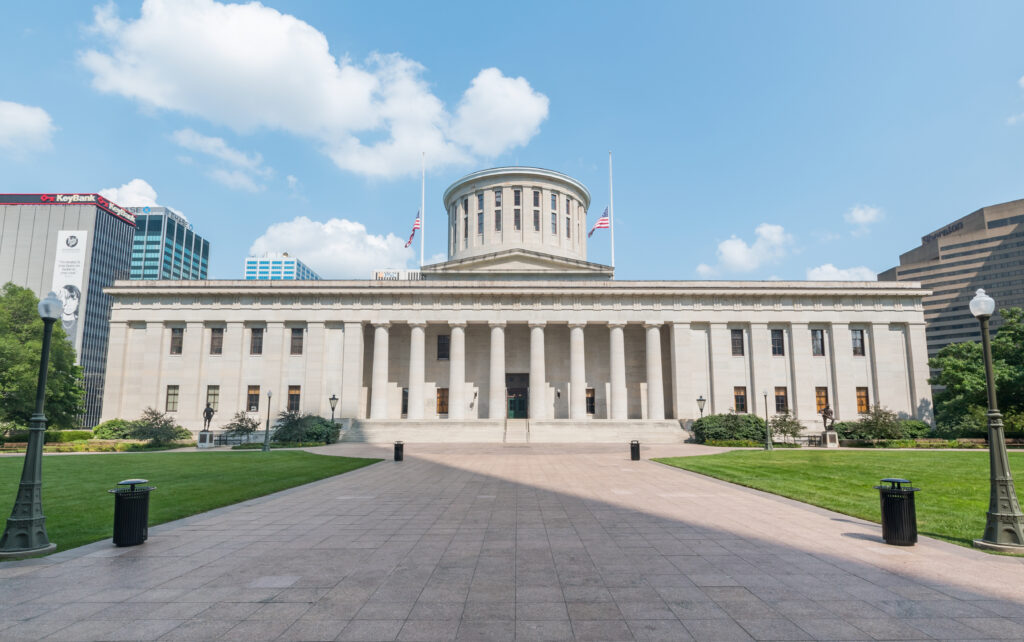
Ohio Statehouse

When Jerell Blakeley walks through the headquarters of the Ohio Education Association in Columbus, he carries with him an unmistakable sense of forward motion. It is not the hurried pace of someone overwhelmed by responsibility. It is the steady, deliberate energy of a leader who believes deeply in where he is going, and in the people he is going with.

At 38 years old, Blakeley is stepping into one of the most consequential union leadership roles in the Midwest as the Ohio Education Association’s new Assistant Executive Director–Program. But if you ask him what he plans to do, he does not begin with bullet points or policy jargon. He begins with hope.

Ohio has a chance to be a model for what a 21st-century public education system can look like: collaborative, innovative, joyful, and anchored in the dignity of the profession.

He settles into a chair with the reflective ease of someone who knows that optimism is not naïveté, but strategy. His vision is sweeping yet grounded. It is not about slogans but about restoring something fundamental: belief, belief that schools can unite communities, that policy can elevate rather than constrain, and that educators can lead the way into a brighter future.

Roots: A Journey Shaped by Possibility

Blakeley’s ascent to this moment did not begin in Columbus. It began in Trenton, New Jersey, where he grew up surrounded by complexity, contradiction, and community strength. Trenton, its grit, its beauty, its activism, sharpened his sense of purpose long before he had the vocabulary for it.

“As a kid in Trenton, I learned that schools aren’t abstract institutions,” he reflects. “They’re the heartbeat of neighborhoods. They’re where dreams get encouraged, or quietly crushed.”

From Trenton, he carried not only ambition but gratitude. He remembers classrooms full of expectation, teachers who demanded excellence, and adults who insisted that public education could transform lives. Those early experiences led him directly into teaching. Standing in front of students, he learned the weight of responsibility and the power of presence.

“Teaching changed me,” he says. “It made me understand that hope is a discipline. You have to practice it, especially on the hard days.”

Indianapolis: Where Hope Evolved into Leadership

By the time Blakeley arrived in Indianapolis, he carried both the heart of a teacher and the instincts of an organizer. Indianapolis refined something essential in him: a leadership style rooted in empathy, courage, and coalition.

His years there were productive and meaningful, relationships flourished, programs expanded, and a diverse community embraced him as both a collaborator and a convener. But when he talks about Indianapolis now, he speaks less about accomplishments and more about what the city taught him.

“Indianapolis stretched me. It gave me a deeper understanding of people, their stories, their struggles, their pride. It taught me how to lead not from ego, but from service.” He lights up when discussing Indiana educators: “They’re resilient, brilliant, and deeply committed to kids. Being part of that community was one of the great blessings of my career.”

Indianapolis did not harden him. It expanded him. It revealed that even in polarized climates, progress is possible when people feel seen and trusted.

The NJ WEC Chapter: A Different Kind of Education

Another defining period in Blakeley’s life came at the New Jersey Work Environment Council, an organization at the intersection of labor rights, environmental justice, worker safety, and community advocacy. There, he learned to think structurally, to understand systems not only as they are, but as they should be.

“WEC taught me that you don’t need to accept the status quo,” he says. “You can design something better.” He still speaks of that chapter with pride. “It opened my eyes to how broad the fight for dignity really is. Schools, workplaces, communities, they’re all connected. And when you lift one, you lift all.”

Arriving in Ohio: Hope as a Strategy

To understand why Blakeley is so energized by his new role in Ohio, you need to understand what he sees, not just the challenges, but the extraordinary potential. Ohio, in his view, is a place full of possibility. A state with urban innovation, suburban stability, and rural pride. A state with educators who care deeply about kids and communities. A state ready for a new story.

“I didn’t come to Ohio to replicate anything I’ve done before,” he says. “I came because I believe Ohio can lead the nation.” His hopes for OEA are expansive, imaginative, and deeply human. They center on four pillars.

1. A New Culture of Collaboration

Blakeley envisions an OEA where departments work like a symphony, each section distinct yet harmonized. “When people collaborate with trust, creativity explodes.” His hope is to cultivate a culture where ideas flow freely, where educators feel heard, and where advocacy becomes a collective, joyful act of leadership.

2. A More Human Approach to Policy

For Blakeley, policy is not a spreadsheet, it is the story of a child, a classroom, a community. “I want us to talk about policy the way educators talk about students: with understanding, with nuance, with heart.” He hopes to elevate educator experiences so powerfully that lawmakers feel compelled to act with conscience and clarity.

3. A New Era of Storytelling

He envisions OEA becoming one of the most compelling communicator organizations in the nation, telling the stories of Ohio educators with dignity and depth. “There is nothing more powerful than a teacher’s story,” he says. “We need the public to feel what educators feel.”

4. A Future Where Educators Lead the Way

Perhaps most central to his vision is this: empowering educators as architects of their own profession. “Educators shouldn’t be passengers in the policy process, they should be the drivers.” He imagines a future where educators are not only celebrated, but truly consulted; not only supported, but elevated; not only defended, but positioned as leaders of statewide change.

The Power of Optimism

In an era when cynicism dominates political conversation, Blakeley’s optimism is almost subversive. He laughs when asked why he remains hopeful. “Hope is the most radical thing you can offer right now,” he says. “But it’s also the most practical. Nothing meaningful has ever been built without it.”

His optimism is not blind. It is intentional, what scholars call radical hope. A hope rooted in clarity, in lived experience, and in the belief that people want a better world for their children. “What I love about Ohio,” he says, pausing for emphasis, “is that people here believe in possibility. They want to build something. And I want to help them build it.”

The Personal Side of Leadership

Blakeley’s leadership is not abstract. It is shaped by the people and places that gave him confidence, compassion, and courage. From Trenton, he carries resilience. From teaching, he carries empathy. From NJ WEC, he carries structural insight. From Indianapolis, he carries maturity and service. And now, in Ohio, he carries hope.

He talks often about gratitude, for family, mentors, educators, and communities that nurtured him. “The truth is, everything I do is a thank-you to the people who believed in me.” It is an anchor that keeps him grounded, even as his influence grows.

A Leader for This Moment

Those who work with Blakeley describe him as steady, reflective, and deeply mission-driven. He listens more than he speaks. He asks good questions. He values people. And he leads softly, but powerfully. He is, in many ways, the kind of leader public education needs now: someone who believes deeply in educators, who sees both the challenges and the possibilities, and who carries both with humility.

“Ohio has extraordinary teachers,” he says. “They deserve extraordinary support. My hope is that my leadership helps create the conditions for them to thrive.”

A Future Full of Light

As Ohio stands at a crossroads, politically, culturally, economically, Blakeley’s arrival feels like a renewal of possibility. Not because he promises quick fixes, but because he offers something more durable: hope paired with strategic imagination. He hopes to build bridges. He hopes to strengthen public trust. He hopes to elevate educator voice. He hopes to unify communities. He hopes to inspire new leaders. He hopes to help Ohio become a model of what public education can be.

My dream is that five years from now, people look at Ohio and say, ‘Something special happened there.’ Something bold, something collaborative, something human.

He smiles, then adds: “And I want OEA to be at the heart of it.” This is what makes Blakeley not just an executive, but a visionary: his belief that positive change is not only possible, it is inevitable when people lead with courage, compassion, and purpose.

And as he begins this new chapter in Ohio, there is one thing certain: the future looks bright. Very bright indeed.

Jerell A. Blakeley
← All writing & press
Op-Ed

What Dr. Bethune Left Us and What Secretary DeVos Brings Us

February 2024 · 6 minute read
What Dr. Bethune Left Us and What Secretary DeVos Brings Us

A few days ago, I watched a History Makers interview of Florida’s first black Congresswoman Carrie Meek. Before her pioneering work as an elected representative in the halls of Tallahassee and Washington D.C., Congresswoman Meek worked as an educator and administrator at Bethune-Cookman University under the tutelage of famed black leader and educator Dr. Mary McLeod Bethune.

Recounting Dr. Bethune, Congresswoman Meek said “I learned how to make do and how to make something out of very little. And that’s something Mrs. Bethune taught. I said she was a conservationist because she taught us to do something with what we had and to try to work hard to make the school better. And Mrs. Bethune taught that routine over and over again. She taught sacrifice over and over again.”

We often hear of the legacy of Johnson at Howard, Patterson at Tuskegee, and Mays at Morehouse in the public’s consciousness regarding black colleges. Dr. Bethune’s work as a presidential advisor and active club woman often overshadows her work as an institution builder.

While her presidential contemporaries often played exclusively in either academia, civic life, or public policy, Dr. Bethune was influential in the halls of Washington, the skyscrapers of New York, and the backwoods of the South. Bethune-Cookman University owes its name and very existence to this resourceful woman. While most private black colleges are named after white male financiers and black male bishops, Bethune-Cookman is the only private HBCU named after a black woman. In my humble estimation, we don’t hear enough about Dr. Bethune and her legacy as a black college presidential icon.

Until today.

Confronted with a rousing chorus of condemnation, Bethune-Cookman University President Dr. Edison Jackson recently defended his choice of U.S. Secretary of Education Betsy DeVos as his university’s Commencement Orator by bringing his university’s namesake into the morass. In a statement, Dr. Jackson stated, “Much like Dr. Bethune, Founder of Bethune-Cookman University, Secretary DeVos deems the importance of opportunity and hope for students to receive an exceptional education experience. Her mission to empower parents and students resonates with the history and legacy of Dr. Bethune.”

I can understand Dr. Jackson meeting with President Trump. I defended it. I can understand Dr. Jackson trying to do everything possible to keep Bethune-Cookman’s doors open in the face of recent credit downgrades and two former Bethune-Cookman trustees suing the university for supposed financial malfeasance. I get it.

What I can’t understand is the need to prostitute the legacy of Dr. Bethune by connecting her to Secretary DeVos, someone whose short tenure in public life is antithetical to everything that Dr. Bethune stood for. It’s one thing to hold your nose and meet President Trump in the Oval Office. It’s another thing altogether to politicize your student’s graduation ceremony with a commencement orator like Secretary Betsy DeVos. Extending the honor of a commencement address invitation to Secretary DeVos is tantamount to selling what Dr. Bethune left us for a proverbial mess of pottage.

Let me explain.

Shortly before her death, Dr. Bethune left us with her Last Will & Testament. In the summation of her life’s work, Dr. Bethune said “Sometimes I ask myself if I have any other legacy to leave. Truly, my worldly possessions are few. Yet, my experiences have been rich. From them, I have distilled principles and policies in which I believe firmly, for they represent the meaning of my life’s work. They are the products of much sweat and sorrow.”

And what exactly did Dr. Bethune leave us?

Dr. Bethune left us hope.

According to Dr. Bethune, “The Negro’s growth will be great in the years to come. Yesterday, our ancestors endured the degradation of slavery, yet they retained their dignity. Today, we direct our economic and political strength toward winning a more abundant and secure life.”

What does Secretary DeVos bring us? Secretary DeVos brings us the removal of Obama era student loan protections to graduates of Bethune-Cookman University, who on average hold more than $36,000 in student debt. In the face of only 21% of Bethune-Cookman students paying down their student loan debt, Secretary DeVos is making it tougher for recent Bethune-Cookman graduates to win a “more abundant and secure life” that Dr. Bethune wrote about.

Dr. Bethune left us a thirst for education.

According to Dr. Bethune, “Knowledge is the prime need of the hour. We are making greater use of the privileges inherent in living in a democracy. If we continue in this trend, we will be able to rear increasing numbers of strong, purposeful men and women, equipped with vision, mental clarity, health and education.”

What does Secretary DeVos bring us? Secretary DeVos brings us the destruction of one of the privileges inherent in a democracy, a public education. Described as the “four-star general of the school voucher movement,” Secretary DeVos is a strong proponent of the dubious school choice movement, supporting “vouchers and tax credits, certainly, but also virtual schools, magnet schools, homeschooling, and charter schools.”

Dr. Bethune left us racial dignity.

According to Dr. Bethune, “I want Negroes to maintain their human dignity at all costs. We, as Negroes, must recognize that we are the custodians as well as the heirs of a great civilization. We have given something to the world as a race and for this we are proud and fully conscious of our place in the total picture of mankind’s development.”

What does Secretary DeVos bring us? Secretary DeVos brought us the dubious notion that HBCUs were “pioneers of school choice” instead of a result of racists who cried out in the halls of Congress and southern legislatures that black folk could not and would not enter traditionally all-white universities.

Dr. Bethune left us a respect for the use of power.

According to Dr. Bethune, “We live in a world which respects power above all things. Power, intelligently directed, can lead to more freedom. Unwisely directed, it can be a dreadful, destructive force.”

What does Secretary DeVos bring us? Secretary DeVos brings us oligarchy. When confronted with accusations regarding her influence peddling, Secretary DeVos said, “I have decided to stop taking offense at the suggestion that we are buying influence. Now I simply concede the point. They are right.”

Dr. Bethune left us a responsibility to our young people.

According to Dr. Bethune, “The world around us really belongs to youth for youth will take over its future management. Our children must never lose their zeal for building a better world. We have a powerful potential in our youth, and we must have the courage to change old ideas and practices so that we may direct their power toward good ends.”

What does Secretary DeVos bring us? Secretary DeVos brought us a laissez-faire charter school policy agenda for Michigan’s public schools, particularly in Detroit, that has resulted in utter failure. “The bottom line should be, ‘Are kids achieving better or worse because of this expansion of choice?’” said Michigan State Board of Education President John Austin. “It’s destroying learning outcomes, and the DeVoses were a principal agent of that.”

What Dr. Bethune left us, Secretary DeVos is committed to taking. Bethune-Cookman University President Edison Jackson, give Secretary DeVos a call and tell her thanks, but no thanks.

For Dr. Bethune’s sake.